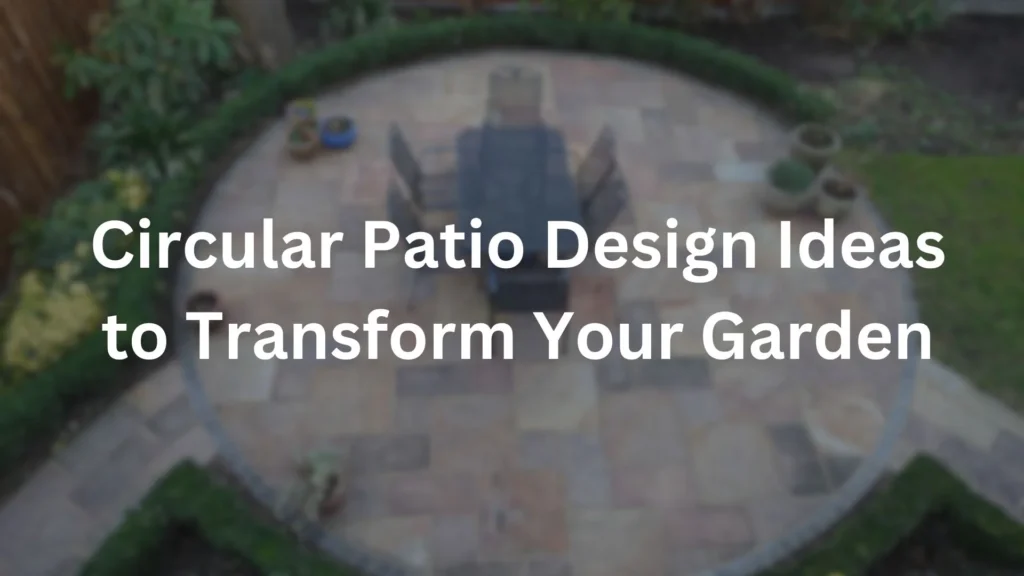
Most patios are square or rectangular, and for good reason. They are simple to lay and easy to fit against a house wall. A circular patio is different. It softens the hard lines of a garden, creates a natural focal point, and gives a space the feel of a destination rather than an extension of the house.
At JPD Landscaping & Building Services, we have built circular patios across South East London for over 15 years. This guide shares design ideas that work in real gardens, explains how to choose the right size, and covers the mistakes that stop a circular patio looking as good as it should.
Why Choose a Circular Patio?
A circle works against the grain of most gardens, which are made up of straight fences, straight walls and rectangular lawns. That contrast is exactly what makes a circular patio so effective. It breaks up the geometry, draws the eye, and gives the garden a sense of flow.
A circular patio also works well as a separate zone. Placed away from the house, it becomes a destination, somewhere you walk to for a coffee, a fire pit evening or a quiet corner. In smaller gardens, a circle can also make better use of space than a large rectangle, because it leaves room for planting and curves around it.
There is a practical side as well. A round table and chairs sit naturally on a round patio, with no awkward corners left empty. The whole surface feels used.
Circular vs Square Patios
Before settling on a circle, it helps to know how it compares with a standard layout.
| Factor | Circular Patio | Square or Rectangular Patio |
| Visual effect | Soft, eye catching focal point | Neat, practical, blends with the house |
| Cutting and waste | Higher, because slabs are cut to the curve | Lower, most slabs are laid whole |
| Labour time | Longer, set out and cut carefully | Shorter and more straightforward |
| Overall cost | Higher | Lower |
| Best for | Feature areas and destination spaces | Main entertaining areas against the house |
A circular patio does cost more than a square one of similar area. There is extra cutting and waste, and more labour is needed to set out the circle and cut the edge slabs accurately. For many customers the visual payoff is worth it, but it is worth budgeting for from the start. Our guide on how much it costs to landscape a garden shows where a feature patio fits into a wider project budget.
How Big Should a Circular Patio Be?
Most of the circular patios we build in South East London fall between 2.5 and 3.5 metres across. That is large enough to be genuinely useful, yet small enough to sit comfortably in a typical garden. The right size depends on what you plan to put on it, so think about furniture before you decide.
| Diameter | Typical Use |
| About 2.5m | A bistro table and two chairs |
| About 3m | A four seat dining set with room to move |
| About 3.5m | A larger dining set, or a fire pit with seating around it |
These are guides rather than fixed rules. Remember to leave space around the furniture, because chairs need room to pull out. As a rough rule, allow at least a metre between the edge of the table and the edge of the patio so people can sit and stand comfortably.
Choosing Paving for a Circle
The paving you choose affects both the look and the cost of a circular patio. Natural stone gives a warm, traditional character, and our guide on how to build a stone patio explains what to expect from the material. Porcelain offers a very consistent, low maintenance surface, while good concrete slabs suit tighter budgets.
Whichever material you choose, remember that every edge slab will need cutting. Harder, denser materials take more time to cut cleanly, which is one reason the paving choice has a bigger effect on the price of a circle than it would on a simple rectangle.
Eight Circular Patio Ideas
1. Pre-Cut Circle Kits
The simplest route to a circular patio is a pre-cut circle kit. These come as a set of shaped pieces designed to fit together into a perfect circle, usually in a fixed diameter. Because the cutting is done at the factory, the finished edge is accurate and consistent.
Kits are a popular choice because they reduce waste and make the layout straightforward. They are also available in a range of finishes, including natural stone and porcelain effects, so you can match the circle to the rest of your garden.
2. Cut Slabs for a Custom Size
If you want a circle in a specific diameter, or you are working with paving you already have, individual slabs can be cut to fit. This gives you complete control over the size and the layout, and it lets you match the paving to the rest of your garden exactly.
The trade-off is time and skill. Cutting slabs to follow a curve takes care, and it needs the right equipment to get a clean, accurate edge. This is the method we use most often, and the one where experience makes the biggest difference to the finished result.
3. A Contrasting Ring Border
A ring of contrasting paving or setts around the outside of the circle adds definition and a designed feel. Darker setts around lighter paving, or the other way round, make the circle stand out clearly against the lawn or planting.
The border also solves a practical problem. It gives the cut slabs a neat finish at the curved edge, and it acts as a firm restraint that keeps the whole circle stable over time.
4. A Fire Pit Centrepiece
A circle and a fire pit are a natural pairing. Placing a fire pit at the centre gives the patio an obvious focal point and draws people in around it. Seating can be arranged in a ring around the fire, and the round shape makes every seat part of the conversation.
For this idea, think about size first. A fire pit with seating around it needs more room than a simple table, so aim towards the larger end of the size range. It is also worth making sure the paving beneath and around the fire pit suits the heat, and that safe clearances are kept.
5. A Compact Bistro Circle
Not every garden has room for a large patio. A small circle of around two and a half metres makes a charming spot for a bistro table and two chairs, tucked into a corner or at the end of a path.
This idea works especially well in small gardens, where a compact circle gives you a defined seating spot without taking over the whole plot. Surround it with planting to make it feel like a hidden retreat.
6. Radial Patterns and Paving Layouts
The way you lay the paving changes the look of the circle. A radial pattern, where cuts fan out from the centre, draws the eye inward and emphasises the shape. Concentric rings of setts or brick create a more formal, traditional feel, almost like a mosaic.
Both layouts take more time and care than a standard grid, so they sit at the higher end of the cost range. They can be well worth it for a feature patio where the design is the point.
7. Planting and Soft Edges
A circular patio looks even better when planting echoes its curve. A ring of low planting, curved flower beds or a gravel border around the edge softens the transition between paving and garden. Lavender, grasses and low shrubs all work well and suit a wide range of garden styles.
Leave a clean edge between the planting and the paving, so soil does not spill onto the patio. A narrow strip of setts or metal edging works well for this. For more help with colour and planting choices, see our guide on how to decorate an outdoor garden.
8. Lighting for Evening Use
Lighting turns a circular patio into an evening feature. Low level lights around the edge pick out the curve, while a single warm light above or within the seating area creates atmosphere. Because the shape is so clear, even simple lighting makes a strong impression after dark.
Plan the cabling and light positions before the paving goes down. Adding them afterwards often means lifting slabs, which is disruptive and expensive. Our guide on how to install landscape lighting walks through the options in more detail.
How We Set Out a Circular Patio
Getting a clean, true circle is mostly about careful preparation. Here is how we approach it on a typical project.
Step 1: Mark the Centre Point
We fix a central peg at the exact middle of the patio. Every measurement for the circle comes from this point, so it needs to be accurate and secure.
Step 2: Draw the Circle
A string line tied to the centre peg, cut to the radius of the circle, is swung around to mark the edge. Marking the line in paint or sand as we go gives a clear guide for excavation.
Step 3: Prepare the Base
The area is excavated and a compacted sub-base laid, followed by the bedding layer, just as for any patio. The base should extend slightly beyond the edge of the circle, so the edging has firm support.
Step 4: Lay and Cut the Paving
Slabs are laid from the centre outwards, or from a straight reference line, and the edge pieces are cut to follow the curve. Each cut is checked against the marked line, so the finished edge is smooth rather than faceted.
Step 5: Edge and Finish
The edge is finished with setts, metal edging or a border, bedded and backed so it holds firm. The joints are then filled, and the surface is checked for level and fall.
Common Circular Patio Mistakes
Circles are less forgiving than rectangles, because any error is easy to see. These are the mistakes we come across most often.
- Setting out badly. If the centre peg moves, or the string is not kept taut, the circle ends up lopsided or slightly oval. The error is hard to correct once paving is laid.
- Uneven cuts at the curved edge. Rough or inconsistent cuts leave visible gaps and a jagged outline, which spoils the clean shape that makes a circle appealing.
- No fall for drainage. A circular patio still needs a gentle fall so water runs away. Without it, water pools on the surface, particularly in the middle.
Each of these is avoidable with careful setting out, accurate cutting and proper attention to levels. They are also the main reason that a circular patio laid by an inexperienced installer so often looks slightly off.
Drainage on a Circular Patio
Drainage is one of the less obvious challenges of a circular design. On a rectangular patio, the fall usually runs in one direction, away from the house. On a circle, there is no single direction, so the fall needs more thought.
Where the circle sits away from the house, a gentle fall from the centre outwards, or from one side to the other, keeps water moving. Where it is close to the house, the fall should always run away from the building. The aim is always the same: water should never be left sitting on the surface or tracking back towards a wall. If your garden already struggles with standing water, it is worth planning this at the design stage rather than fixing it afterwards.
Looking After a Circular Patio
A circular patio needs the same simple care as any other. Sweep it regularly, wash it with warm water and a mild detergent a couple of times a year, and keep the joints topped up so slabs stay locked in place. Pay particular attention to the curved edge, where the border or edging does the important job of holding the cut slabs firmly together.
It is also worth checking the edge now and then for any lifting or movement, especially after a wet winter. Catching a loose border early is a small repair, while a neglected one can allow the outer slabs to creep and the curve to lose its crisp shape.
Project Example: A Circular Patio with a Fire Pit
One of our typical projects involved a customer in South East London who wanted a separate seating area at the end of their garden, away from the main patio by the house.
| Detail | Specification |
| Patio shape | Circular, about 3.5m across |
| Paving | Natural stone effect slabs, cut to the curve |
| Edging | A contrasting ring of darker setts |
| Feature | A central fire pit with seating around it |
We set out the circle carefully from a central peg, laid a compacted base with a gentle fall for drainage, and cut each edge slab to follow the curve. A ring of darker setts around the outside gave the circle a crisp, framed edge and acted as a firm restraint for the cut slabs.
The finished patio has become the customer’s favourite spot in the garden, particularly in the evenings. The clean curve and contrasting border make it look deliberately designed, and the accurate cutting means there are no visible gaps along the edge. It is a good example of how careful setting out and cutting make the difference between an average circular patio and an excellent one.
Frequently Asked Questions
How much does a circular patio cost?
A circular patio costs more than a square one of the same area, because of the extra cutting, waste and labour. The final price depends on the size, the paving you choose and the groundwork needed. A free consultation gives you an accurate figure for your garden.
What size should a circular patio be?
Most circular patios are between 2.5 and 3.5 metres across. Around 2.5 metres suits a bistro set, around 3 metres suits a four seat dining set, and 3.5 metres gives room for a larger set or a fire pit with seating.
Is a circular patio harder to lay?
Yes, it is more demanding than a rectangular patio. The circle needs to be set out accurately, and the edge slabs need to be cut cleanly to follow the curve. This is why experience matters so much with a circular design.
Can I use a pre-cut circle kit?
Yes, pre-cut circle kits are a popular option. They reduce cutting and waste, and they give an accurate, consistent circle in a fixed diameter. They are available in a range of finishes.
Does a circular patio need drainage?
Yes, like any patio, it needs a gentle fall so water runs away. Because a circle has no single direction, the fall needs to be planned carefully, and should always run away from the house if the patio is close to it.
What goes well around a circular patio?
Curved planting beds, low shrubs, grasses and gravel borders all work well. They echo the shape of the circle and soften the edge, and a clean edging strip keeps soil from spilling onto the paving.
Book a Free Consultation for Your Circular Patio
If you are thinking about a circular patio, JPD Landscaping & Building Services offers free consultations across South East London. We can help you choose the right size, layout and paving for your garden, and give you a clear price before any work begins.Book a free consultation today to start planning your circular patio.