If you are paving your front garden in London, the surface you choose does more than set the look of your home. It also decides whether you can avoid a planning application. The national rules for front gardens favour surfaces that let rainwater soak away, and several good options now meet that test.
At JPD Landscaping & Building Services, we have installed driveways across South East London for over 15 years. This guide compares the main permeable options on rules, cost and day to day practicality, so you can narrow down your choice before you ask for quotes.
A quick note first. This is general guidance based on our experience, not legal advice. Rules can change, and local conditions vary, so always confirm your own situation with your council.
Your Permeable Options
Four surfaces are commonly used for permeable driveways. Permeable block paving is the one we install most often in London, resin bound and gravel are the other main choices, and porous tarmac is a further option that we do not install ourselves.
| Surface | Typical Cost | Approx. Cost for 25m² | Best For |
| Permeable block paving | £110 to £140 per m² | £2,750 to £3,500 | A classic look with easy repairs |
| Resin bound | £100 to £130 per m² | £2,500 to £3,250 | A smooth, modern finish |
| Gravel with base and grid | £70 to £90 per m² | £1,750 to £2,250 | A lower cost option |
| Porous tarmac | Not quoted by us | Ask a specialist | Larger areas, through a specialist |
Resin bound often costs a little more once groundwork and surface preparation are included. All of these figures assume reasonably straightforward ground.
What the Rules Say About Permeable Surfaces
In England, paving a front garden is generally allowed without planning permission if the surface is permeable. If you use a surface that does not let water through, and the area is larger than 5 square metres, you will usually need permission. The exception is where rainwater drains to a lawn, a border or another permeable area within your property.
The rule exists to reduce surface water running into the drains, which helps limit flooding. Greater London follows the same national rule, but each borough applies it, and some have extra local restrictions, which we cover below.
What Permeable Really Means
A surface is permeable only if water can pass through it and into the ground below, or if it drains to a permeable area. That depends on the whole build up, not just the top layer. A permeable surface laid on a solid, impermeable base may not meet the rule in practice.
A properly designed permeable driveway usually has several layers working together:
- A surface layer that lets water through, such as open jointed blocks, porous resin or gravel
- A bedding layer of clean stone rather than sand that would hold water
- An open graded sub-base with gaps between the stones, which stores water and releases it slowly
- A geotextile membrane that keeps soil from washing into the stone below
- Edge restraints that hold everything in place without blocking the flow of water
This is why the base and drainage design matter as much as the surface you can see. When we plan a driveway, we look at both together.
Why London Adds Extra Considerations
London properties tend to have a few features that make the permeable question more involved than it is elsewhere.
- Clay soil. Much of London sits on clay, which drains slowly. A permeable surface still needs somewhere for the water to go, so the base and drainage design need extra thought.
- Small front gardens. On a compact frontage, there is often little room for a separate soakaway or a large lawn to take the runoff.
- Conservation areas and Article 4 directions. Many London streets have extra restrictions that can remove normal permitted development rights, so permission may be needed even for a permeable surface.
- Flats and maisonettes. These often do not have the same rights as houses, so permission is commonly needed regardless of the surface.
- Dropped kerbs. A new vehicle access across the pavement needs separate council approval, whatever surface you choose.
None of these rule out a permeable driveway. They simply mean a site visit is worth having before you commit to a design.
Checking the Position With Your Borough
Because London is split into 32 boroughs plus the City, local practice varies more than most homeowners expect. Before you settle on a design, it is worth taking a few simple steps with your own council.
Start by looking at the planning section of your borough’s website, where you will usually find guidance on front gardens, crossovers and conservation areas. Check whether your street sits inside a conservation area or is covered by an Article 4 direction, because both can change what you are allowed to do without an application. If anything is unclear, a short enquiry describing the size of the drive, the surface and the drainage plan will often get a clear steer.
If you want certainty in writing, you can apply for a lawful development certificate, which confirms that your proposed driveway is lawful. It costs a fee, but it gives you a document to show future buyers, which can be valuable when you sell. For the dropped kerb, you will follow the council’s separate application process, so it is worth asking about that at the same time. Our guide to planning permission for driveways goes through these checks in more detail.
Option 1: Permeable Block Paving
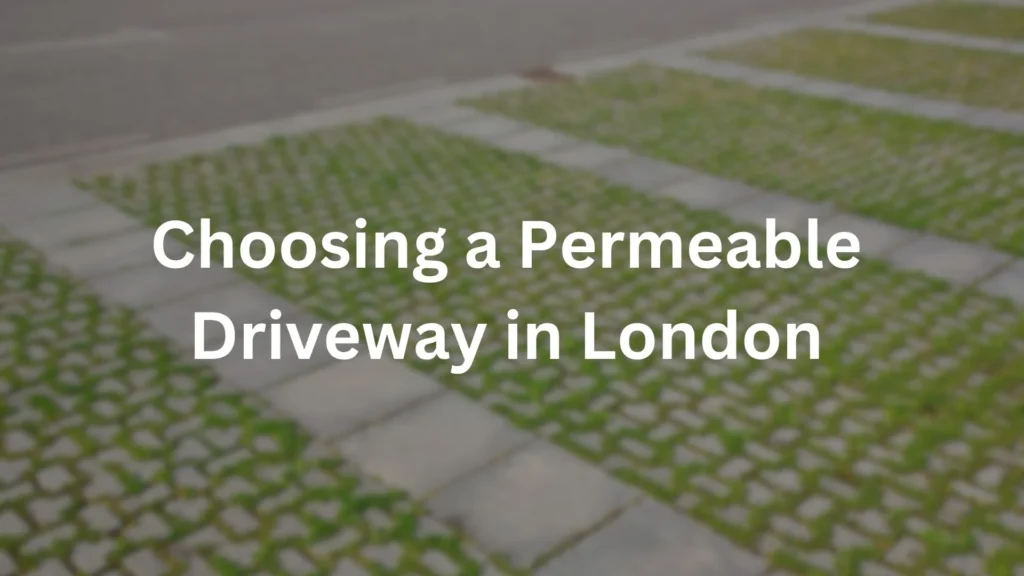
Permeable block paving is the surface we install most often on London driveways. It looks like traditional block paving, but the blocks are laid with wider joints filled with stone chippings rather than sand, over an open graded sub-base that stores and releases water. Rain passes through the joints and drains down through the layers.
It typically costs £110 to £140 per square metre, including the permeable sub-base. That is slightly more than standard block paving, because the base is deeper and uses specialist material.
Why We Like It
- It keeps the classic look, with the full range of colours and patterns.
- Individual blocks can be lifted and replaced, so repairs are simple.
- It is very strong under vehicles when laid on a proper base.
- The sub-base acts as a reservoir, which helps on slower draining ground.
Things to Watch
- The joints can clog with silt or debris over time, so occasional brushing and topping up is needed.
- It needs a deeper excavation than standard paving, which adds to the groundwork.
Option 2: Resin Bound
Resin bound is made by mixing natural stone aggregate with a clear resin and trowelling it onto a prepared base. The surface is smooth and seamless, and because the resin coats the stones without filling the gaps between them, water drains through. To stay permeable, it must sit on a base that also lets water through.
It typically costs £100 to £130 per square metre, and usually works out a little higher overall once groundwork and surface preparation are included. If you are torn between this and block paving, our comparison of resin bound and block paving driveways looks at both side by side.
Why People Choose It
- A smooth, modern look in a wide range of colours.
- No joints, so weeds have nowhere to grow.
- Low upkeep, with no sand to replace.
- A comfortable surface for prams, wheelchairs and bare feet.
Things to Watch
- It needs a very stable, well prepared base, or it can crack.
- It must be laid in dry weather, so timing can be limited.
- Repairs can show against the original surface.
Option 3: Gravel
Gravel is permeable by nature, and it is the most affordable of the options. For a driveway to work properly, though, it needs more than a layer of stones on soil. A compacted base, a stabilising grid to stop the gravel rutting, and firm edging all make a big difference.
With a proper base and grid, gravel typically costs £70 to £90 per square metre.
Why It Suits Some Homes
- It is the lowest cost permeable surface.
- It drains freely and is simple to top up.
- It gives a natural, informal look.
Things to Watch
- Loose gravel can spill onto the pavement or road, so it needs good edging and a firm boundary.
- It is harder for prams, wheelchairs and bins, and it can be noisy underfoot.
- It needs occasional topping up and raking.
Option 4: Porous Tarmac
Porous tarmac, sometimes called porous asphalt, is an open textured surface that lets water drain through to a stone base beneath. It is a recognised option for permeable driveways, and it is often used on larger areas.
We do not install porous tarmac ourselves, so we cannot quote a price. If it appeals to you, speak to a specialist contractor, and ask them to confirm how the whole build up, including the base, meets the permeable requirement.
Comparing Day to Day Practicality
Cost and rules are only part of the picture. It is worth thinking about how each surface will feel to live with over the years.
Permeable block paving is the most forgiving in daily use. It handles heavy vehicles well, and if a utility company needs to dig beneath it, the blocks can be lifted and relaid with no visible patch. Resin bound is the easiest to keep tidy and the most comfortable underfoot, but it is the least forgiving if the ground beneath it moves or if repairs are needed.
Gravel sits at the other end of the scale. It is cheap and drains well, but it takes more effort to keep neat, and it is less suited to a busy household with bins, buggies and bikes. If your front garden also needs levels changing or soil holding back, the groundwork may involve a retaining wall before any surface goes down, which affects your overall budget more than the choice of surface itself.
Which Option Should You Choose?
The best surface depends on your priorities, your property and your budget. As a rough guide:
- Choose permeable block paving if you want a classic look, strong performance under vehicles, and easy repairs.
- Choose resin bound if you want a smooth, modern finish and minimal upkeep, and your site can provide a stable base and a dry weather window.
- Choose gravel if keeping costs down matters most, and you are happy with a more informal surface and a little upkeep.
- Consider porous tarmac only if you are working with a specialist who can confirm it suits your site.
If your home is in a conservation area, or you are in a flat, check the planning position first, because that can shape the choice more than cost does.
What Drives the Final Cost
Per square metre figures are a useful starting point, but the final price depends on what is beneath and around the surface. Groundwork is usually the biggest variable. Breaking out an old driveway, digging to the depth a permeable sub-base needs, and taking away the spoil often costs more than the surface itself.
Other factors add to the total:
- The size and shape of the drive, since awkward shapes mean more cutting and waste
- Access for machinery and materials, which affects how long the job takes
- Edging and borders, which vary widely in cost depending on the material
- A new dropped kerb, which is a separate cost from the paving
- Any boundary work, such as new gates or walls, which can have their own height limits. Our guide on how high a garden fence can be explains the general limits
If the driveway forms part of a larger scheme, our guide on how much it costs to landscape a garden shows how it fits into a wider budget.
Common Mistakes with Permeable Driveways
We see the same mistakes again and again, and they often appear together.
- Assuming a surface is permeable without checking the base. A permeable top layer on an impermeable base may not drain, and may not meet the rule.
- Ignoring slow draining ground. On clay, a permeable surface with no allowance for slow drainage can leave water sitting on or under the driveway.
- Letting the joints clog. Silt, leaves and debris can block the joints in permeable block paving, which stops the surface draining as designed.
All three are avoidable with proper design and a little regular upkeep.
Keeping a Permeable Driveway Working
A permeable driveway only stays permeable if it is looked after. The good news is that the routine is simple.
- Sweep the surface regularly to keep leaves and debris out of the joints.
- Brush fresh chippings into permeable block paving where they have washed out.
- Keep an eye on shaded areas, where moss and algae can build up and slow drainage.
- Wash the surface occasionally, using care so you do not blast the joint material away.
A few minutes of attention each season is much cheaper than dealing with a driveway that no longer drains. Our guide on how to clean patio slabs covers the right pressure and technique for washing paved surfaces without damaging the joints.
Project Example: A Permeable Driveway on London Clay
One of our typical projects involved a South East London home with a worn front lawn and a small concrete pad. The owners wanted block paving for two cars and were concerned about the planning rules.
| Detail | Specification |
| Driveway size | About 22m² |
| Ground | Clay soil that drained slowly |
| Surface chosen | Permeable block paving in two tones |
| Base | Deeper permeable sub-base, assessed on site |
| Extra | Dropped kerb arranged separately with the council |
The owners had assumed that any block paving would be fine. During our site visit, we explained that a non-permeable surface over this area would probably need planning permission, and that the clay soil meant the drainage needed careful thought.
We chose permeable block paving, built on a deeper permeable sub-base that works as a reservoir while the water soaks away slowly. The dropped kerb was applied for separately, and we planned the paving around the council approval. The finished driveway looks like traditional block paving, drains properly, and avoided a planning application for the surface.
Frequently Asked Questions
Do I need planning permission for a permeable driveway in London?
Usually not for the surface, if it is genuinely permeable, but there are exceptions. Conservation areas, Article 4 directions, flats and listed buildings can all change the position, and a new dropped kerb needs separate council approval. Check with your borough before starting.
What is the 5 square metre rule?
In England, paving more than 5 square metres of front garden with a non-permeable surface usually needs planning permission, unless the water drains to a lawn, border or other permeable area within your property. A permeable surface avoids this requirement.
Is permeable block paving more expensive?
Yes, slightly. Permeable block paving typically costs £110 to £140 per square metre, because the sub-base is deeper and uses specialist material, whereas standard block paving costs less per square metre.
Is resin bound always permeable?
Not automatically. Resin bound is generally permeable, but only when it is laid on a base that also lets water through. We check each site and advise case by case.
Does gravel count as permeable?
Yes, gravel is permeable by nature, but it still needs a proper base, a grid and good edging to work well as a driveway.
Can I use a permeable driveway on clay soil?
Often yes, but the design needs more care. Clay drains slowly, so the base and drainage need to be planned for the site. A visit to assess the ground is the best way to decide.
Do permeable driveways need maintenance?
A little. Sweeping, topping up joint material and washing occasionally keeps the surface draining. Without that upkeep, joints can clog and slow the drainage.
Can I get written confirmation that my driveway is lawful?
Yes. You can apply to your council for a lawful development certificate, which confirms in writing that your proposed driveway is lawful. It costs a fee, but it can be useful evidence when you sell.
Get a Free Quote for Your London Driveway
If you are planning a permeable driveway, JPD Landscaping & Building Services offers free quotes across South East London. We will check your site, talk through the surface options and drainage, and give you a clear, itemised price before any work begins.
Call now for a free quote and start your driveway project on the right footing.