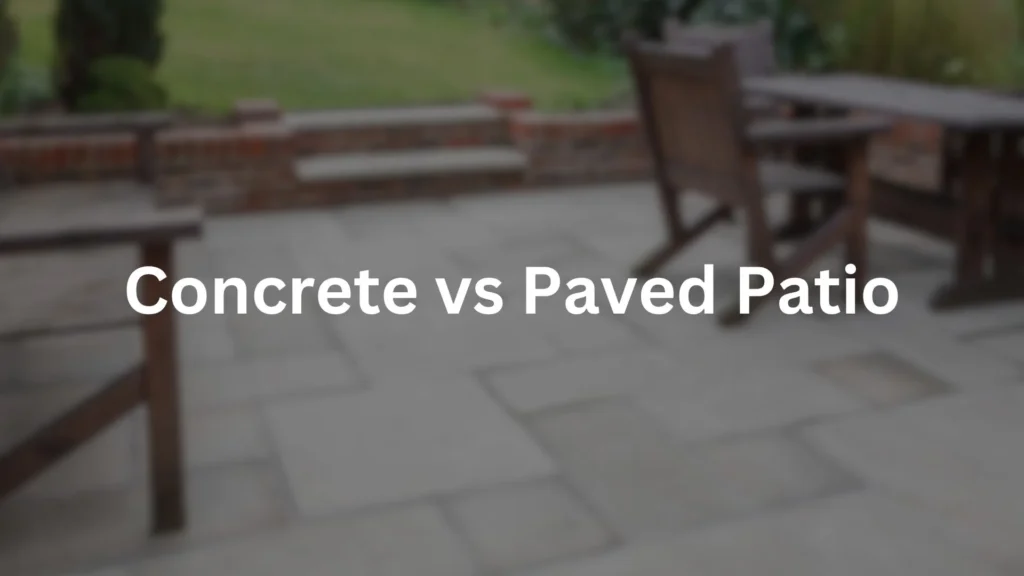
Choosing between a poured concrete patio and a traditional paved slab patio isn’t a case of one being universally better than the other. Both are genuinely solid options, and in our experience, the right choice really does come down to your specific priorities around cost, style, and how you want to handle any future repairs.
At JPD Landscaping & Building Services, we’ve built both poured concrete and paved slab patios across South East London for over 15 years. This guide gives you an honest, practical comparison of the two, covering the genuine advantages and downsides of each, so you can decide what fits your garden and priorities best.
Comparing Concrete and Paved Patios
We don’t have a single go-to recommendation here, it’s roughly an even split depending on what matters most to you. Poured concrete offers a lower cost for large areas, a seamless finish, and faster installation once ground preparation is done. Paved slabs offer far greater style choice and, importantly, are much easier to repair, since you can replace individual damaged slabs rather than needing to break out a whole section.
Cost for Large Areas
Poured Concrete: Generally lower
Paved Slabs: Generally higher
Style or Material Choice
Poured Concrete: Limited without added finishes
Paved Slabs: Wide range (stone, porcelain, colours, patterns)
Repair Approach
Poured Concrete: Difficult, often needs breaking out a section
Paved Slabs: Easy, replace individual damaged slabs
Main Risk
Poured Concrete: Cracking over time without proper expansion joints
Paved Slabs: Jointing maintenance over time
Why This Decision Deserves More Than a Quick Guess
It’s worth being upfront about why we treat this as a genuine, priorities based decision rather than pushing customers toward whichever material happens to be more profitable for us to install. A patio is a long term feature of your garden, typically expected to perform well for a decade or more, and the two materials genuinely diverge in how they age, how they’re repaired, and what they cost across different project sizes. Getting this decision right at the planning stage avoids the frustration of a homeowner discovering years later that their chosen material doesn’t suit how they actually use, maintain, or eventually need to fix their patio.
Why Poured Concrete Has Genuine Advantages
Poured concrete brings a real set of practical benefits, particularly for larger patio areas.
- Lower cost for large areas. Concrete typically works out cheaper than paved slabs across a bigger space, since you’re not paying for the material and labour costs associated with individual slab units and their jointing.
- Seamless finish. Without individual slabs, there are no joints between units for weeds to establish in or algae to build up along, giving a clean, continuous surface across the whole patio.
- Faster installation once ground preparation is done. Once the sub base and formwork are properly prepared, pouring and finishing concrete across a large area can genuinely be quicker than laying and bedding individual slabs one at a time.
These advantages make poured concrete a genuinely strong option for larger, more budget conscious projects, or where a clean, modern, seamless look is the priority. The underlying mixing and pouring technique that makes this fast, seamless installation possible is covered in detail in our guide on how to lay a concrete base, which applies just as much to a poured patio surface as it does to a shed base or other garden slab.
What a Finished Concrete Patio Surface Can Actually Look Like
It’s a common misconception that poured concrete automatically means a plain, grey, purely utilitarian surface, and it’s worth being clear that this isn’t quite accurate. A range of finishing techniques can be applied to a poured concrete patio to considerably improve its final appearance beyond a basic flat pour. Exposed aggregate finishes, where the surface is treated to reveal the natural stone aggregate within the concrete mix, give a textured, decorative look with genuine visual interest.
Coloured or pigmented concrete, mixed with an integral colourant before pouring, moves well beyond standard grey and can be matched to complement a house’s exterior or existing garden features. Stamped or patterned concrete, pressed with a textured mould before the surface fully cures, can even mimic the look of natural stone or block paving to a reasonable degree, though it’s worth being realistic that this rarely achieves quite the same convincing effect as genuine natural stone or high quality porcelain.
These finishing options do add to the overall cost compared with a basic plain pour, which is worth factoring in if style is a genuine priority alongside concrete’s cost advantage for larger areas.
Why Paved Slabs Have Genuine Advantages
Paved slabs bring their own set of real benefits that poured concrete simply can’t match in the same way.
- Much wider style and material choice. From natural stone to porcelain, in a huge range of colours, patterns, and finishes, paved slabs offer a level of design flexibility that a single poured concrete surface generally doesn’t achieve without significant additional finishing work. Our comparison of Indian sandstone vs porcelain paving gives a sense of just how much genuine choice exists within paved slabs alone, before even considering concrete’s more limited palette.
- Easier to repair. This is genuinely one of the most practical long term advantages of paved slabs. If a single slab cracks, chips, or gets damaged, you can lift and replace just that one slab, leaving the rest of the patio completely undisturbed. Concrete doesn’t offer this same flexibility.
- Generally considered a more premium look. For many homeowners, individual slabs, particularly natural stone or high quality porcelain, read as a more considered, higher end finish compared with a plain poured concrete surface.
The Practical Value of Slab-by-Slab Repair
It’s worth expanding on the repair advantage specifically, since this is often the factor that tips a decision once homeowners genuinely think through the long term implications of each material. With paved slabs, a single cracked or chipped unit, whether from a dropped heavy object, frost damage, or simple wear over many years, can be individually lifted and replaced, with the new slab bedded in to match the surrounding level and finish. This is a relatively contained, affordable repair that doesn’t require disturbing anything beyond the immediate affected area.
Poured concrete doesn’t offer this same option. A crack or area of damage in a poured slab generally requires breaking out a defined section, typically bounded by the nearest expansion joints if the original design included them, then repouring that section and allowing it to properly cure before it blends back into the surrounding surface.
This is inherently a bigger, messier, and more disruptive job than lifting a single paving slab, and colour matching a repaired concrete section to older, weathered surrounding concrete can also be genuinely difficult to achieve seamlessly, unlike swapping in a like for like replacement slab.
The Main Downside of Poured Concrete: Cracking
The genuine downside worth flagging with poured concrete is its tendency to crack over time, especially without properly designed expansion joints. Concrete naturally expands and contracts with temperature changes, and without expansion joints built into the design at appropriate intervals, this movement can cause visible cracking across the surface.
This isn’t necessarily a sign of poor workmanship on every occasion, it’s a genuine characteristic of the material that needs to be properly planned for from the outset. Expansion joints, correctly positioned and sized, allow the concrete room to move without cracking, but skipping this step, or getting the spacing wrong, is a common cause of the cracking problems that give poured concrete patios a reputation for this specific issue.
How Expansion Joints Actually Prevent Cracking
It’s worth explaining the mechanism here a bit further, since it directly determines whether a poured concrete patio ages gracefully or develops the random, unsightly cracking that gives the material its reputation. As concrete cures and subsequently experiences ongoing temperature and moisture cycles throughout the seasons, it naturally expands and contracts very slightly. Across a small area, this movement is negligible.
Across a larger continuous slab, without any deliberate weak points designed to accommodate that movement, the concrete has nowhere controlled to release the stress this expansion and contraction creates, and it eventually cracks at whatever point happens to be structurally weakest, rather than at a planned, tidy location.
Expansion joints are deliberately placed, typically at regular intervals related to the slab’s overall dimensions and thickness, giving the concrete a controlled gap where this movement can happen safely without transferring stress into the surrounding slab. Getting this spacing and positioning right is a matter of proper planning at the design stage, similar in principle to how correctly spaced formwork staking, covered in our guide on concrete slab formwork, prevents a different kind of structural problem during the pour itself. Both issues share the same underlying lesson: concrete performs reliably when its natural behaviour is properly planned for, rather than assumed away.
Long-Term Maintenance Comparison
Beyond the headline repair difference, it’s worth comparing ongoing routine maintenance between the two surfaces, since this affects the total time and cost commitment over a patio’s full lifespan, not just the occasional repair. A properly finished, sealed poured concrete surface generally needs relatively little routine attention beyond periodic cleaning, since there are no joints for weeds or algae to specifically establish within, similar in principle to how our guide on how to clean patio slabs covers routine care for jointed paving.
Paved slabs, by contrast, do carry an ongoing jointing maintenance consideration, covered in detail in our guide comparing jointing compound and sand, since joints between slabs, whichever jointing method is used, benefit from periodic checking and occasional attention over the years. This is a genuine, if generally modest, ongoing time commitment that a seamless concrete surface largely avoids, which is worth weighing against paved slabs’ repair advantage when thinking through the full picture of long term upkeep.
Full Comparison Table
Cost (large areas)
Poured Concrete: Generally lower
Paved Slabs: Generally higher
Style flexibility
Poured Concrete: Limited without added finishing
Paved Slabs: Extensive range of materials and styles
Repair if damaged
Poured Concrete: Difficult, often a full section rebuild
Paved Slabs: Straightforward, replace individual slabs
Main long-term risk
Poured Concrete: Cracking without proper expansion joints
Paved Slabs: Jointing maintenance and weed growth over time
Installation speed
Poured Concrete: Fast once ground prep is complete
Paved Slabs: Slower, laid slab by slab
Which Should You Choose?
If your priority is cost efficiency across a large area, a clean seamless finish, and you’re comfortable with proper expansion joint planning to manage cracking risk, poured concrete is a genuinely solid choice. If style flexibility and easy long term repairability matter more to you, particularly the ability to replace individual damaged slabs without disturbing the rest of the patio, paved slabs are generally the better fit.
Neither option is objectively superior, which is exactly why we don’t lead with a strong universal recommendation either way. It genuinely comes down to matching the material to what you value most for your specific garden and budget.
A Few Extra Questions Worth Asking Yourself
Beyond the headline factors covered above, it’s worth working through a few more specific questions that can help clarify which option genuinely suits your situation. How large is your intended patio area, since concrete’s cost advantage becomes more pronounced the bigger the space, while a smaller patio often narrows the price gap between the two materials considerably.
Do you have young children, pets, or heavy garden furniture that gets moved around, where individual slab repairability might matter more than it would for a lower traffic, more carefully maintained space. Are you drawn to a specific natural stone or porcelain look that genuinely can’t be replicated convincingly with a concrete finish, or would a well executed exposed aggregate or coloured concrete surface satisfy your aesthetic preferences just as well at a lower cost.
Working through these questions honestly, alongside the core comparison covered throughout this guide, generally gives a clearer answer than treating the decision as a simple headline cost comparison alone.
Combining Both Materials in One Garden
It’s also worth knowing that some gardens genuinely benefit from using both materials together rather than choosing exclusively between them. A larger poured concrete area, used for a main seating or dining zone, can be paired with a smaller paved slab section, perhaps as a path, a border detail, or a secondary seating nook, giving a garden the cost efficiency of concrete across its largest area while still incorporating some of the style flexibility paved slabs offer in a smaller, more visually prominent spot. This kind of combined approach is worth discussing with whoever is planning your project if you’re finding it genuinely difficult to choose one material exclusively for the whole space.
Frequently Asked Questions
Is concrete or paved patio better?
Neither is universally better, it depends on your priorities. Concrete offers lower cost for large areas and a seamless finish, while paved slabs offer much greater style choice and far easier repair if a slab gets damaged.
Do poured concrete patios crack?
They can, particularly without properly designed expansion joints. This is a genuine characteristic of concrete that needs planning for from the outset, rather than a sign of poor workmanship on every occasion.
Can I repair a single damaged paving slab?
Yes, this is one of the genuine advantages of paved slabs over poured concrete. A single damaged slab can be lifted and replaced individually, without needing to disturb the rest of the patio.
Is poured concrete cheaper than paved slabs?
Generally yes, particularly for larger areas, since you’re not paying for individual slab units and their associated jointing costs.
Which patio type offers more design choice?
Paved slabs offer significantly more style and material choice, including natural stone, porcelain, and a wide range of colours and patterns, compared with a standard poured concrete finish.
Can poured concrete look as good as paved slabs?
With the right finishing technique, such as exposed aggregate, integral colour, or stamped patterns, concrete can achieve a genuinely decorative look, though it typically doesn’t quite match the convincing, varied appearance of natural stone or high quality porcelain.
Can I combine concrete and paved slabs in the same garden?
Yes, some gardens use a larger poured concrete area for cost efficiency alongside a smaller paved section for style, giving a practical middle ground between the two materials.
Book a Free Consultation for Your Patio Project
Whether you’re leaning toward poured concrete or paved slabs, JPD Landscaping & Building Services offers free consultations across South East London to help you choose the right option for your garden.Book a free consultation today to start planning your patio project.